


How much does it cost to replace a gas boiler with an air-source heat pump? Is it possible to keep the existing radiators? And by how much can the cost be reduced thanks to Energy Savings Certificates and the income tax deduction?
At Ubora, we prefer to respond with real projects.
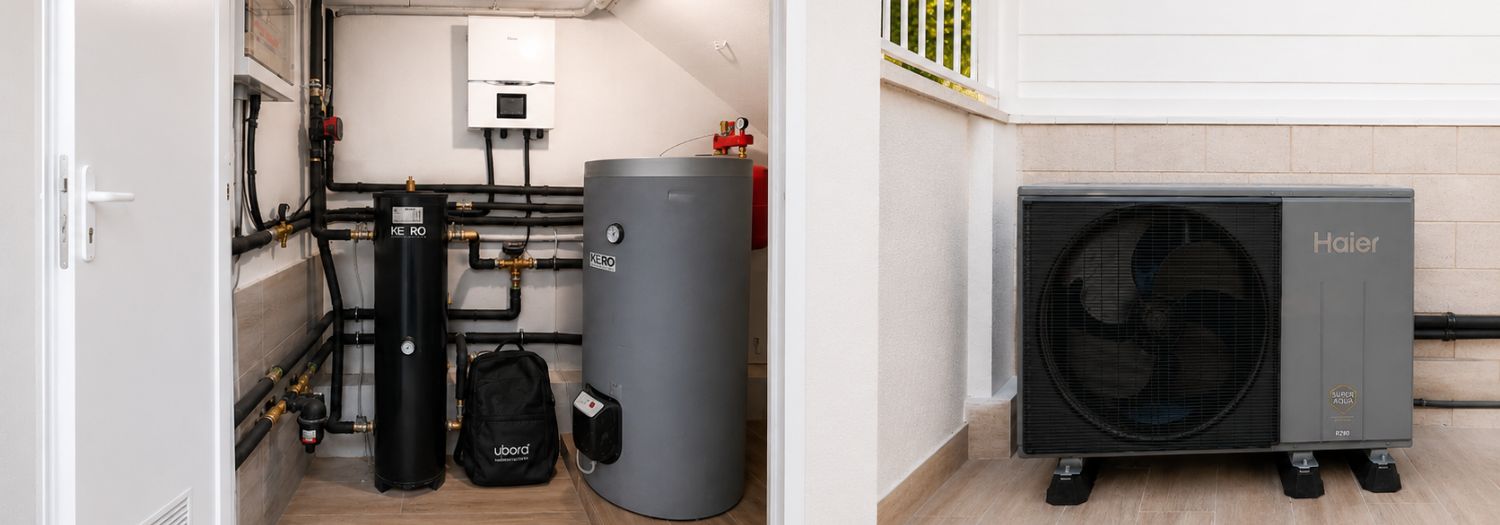
In this success story, which took place in a single-family home in Alcalá de Henares, Madrid, we replaced an old gas boiler with a high-temperature Haier air-source heat pump system.
The goal was clear: to switch from natural gas, keep the existing radiators, and improve the home’s energy efficiency without having to undertake a complete renovation.
The initial investment for the project was 13,000 €, including VAT. After taking into account an estimated reimbursement of €1,900 through Energy Savings Certificates and a potential 60% deduction on personal income tax, equivalent to €7,800, the estimated net cost of the installation is reduced to:
3,300 €
This means that the property can recoup approximately 75% of the initial investment through energy savings and tax deductions.
And on top of this reduction, there are the savings that the home will continue to generate each year by eliminating gas consumption for heating and domestic hot water.
The challenge: switching from natural gas without replacing the radiators
Before the renovation, the home used a gas boiler to provide heat and hot water.
Although the system continued to operate, it required maintaining the gas contract, covering its fixed costs, and continuing to rely on a fossil fuel whose price can fluctuate throughout the year.
The property owners wanted to replace the boiler with a more efficient, renewable solution, but there was one important condition: they wanted to keep the existing radiators and avoid a major renovation involving work on the floors and walls.
Therefore, not just any heat pump would do.
It was necessary to install equipment capable of operating at high temperatures and to properly adapt the hydraulic circuit to ensure stable, efficient operation that was suited to the home’s characteristics.
The solution designed by Ubora included:
- Haier High-Temperature Air-Source Heat Pump.
- Heat generation.
- Domestic hot water production.
- Complete overhaul of the hydraulic system.
- Buffer tank.
- 200-liter hot water storage tank.
- Expansion tank.
- Hydraulic filters.
- Sludge separation system.
- Shut-off and control valves.
- Setup and Commissioning.
- Management of Energy Savings Certificates.
The entire project was coordinated by a single team, from the initial study through to commissioning.
Geothermal Heating with Radiators: Yes, It’s Possible
One of the most widespread myths about aerothermal systems is that they always require replacing conventional radiators with underfloor heating or low-temperature heat emitters.
It doesn’t have to be that way.
In this home, we installed a 12-kW high-temperature Haier air-source heat pump capable of producing water up to 80 °C.
This capability makes it possible to supply power to the existing radiators, thereby avoiding their replacement and significantly reducing the scope of the renovation.
The new system is now responsible for producing:
- Heating via the home’s radiators.
- Domestic hot water.
- Hot water stored in a 200-liter storage tank.
The decision to install a high-temperature air-source heat pump has made it possible to completely replace the old gas boiler without modifying the home’s heating system.
How does an air-source heat pump work?
Aerothermal heating uses a heat pump to extract thermal energy from the outside air and transfer it into the home.
Although it requires electricity to operate, most of the thermal energy it harnesses comes from the environment.
This makes it possible to obtain several units of thermal energy for every unit of electricity consumed, achieving a much higher efficiency than that of electrical systems that operate exclusively using resistors.
In this home, the outdoor unit captures the energy available in the air and transfers it to the water circuit that supplies the radiators and produces domestic hot water.
As a result, the home stops using gas and switches to a high-efficiency electric system.
12 kW Haier Air-Source Heat Pump with R290 Refrigerant
The installed unit is a 12-kW Haier air-source heat pump, designed to operate at high temperatures.
One of its main features is the use of R290 refrigerant, also known as propane.
This refrigerant has a much lower global warming potential than many conventional fluorinated refrigerants and allows the equipment to operate at high discharge temperatures.
These features make the system particularly well-suited for energy-efficiency retrofits in homes that already have conventional radiators.
Among the main benefits of the installed equipment are:
- Hot water up to 80 °C.
- Compatibility with existing radiators.
- Heating and hot water production.
- Removal of the old gas boiler.
- Greater energy efficiency.
- Reduction of direct emissions from the home.
- Use of R290 refrigerant.
- Option to cancel the gas contract.
Hydraulic adaptation: a key part of the project
Replacing a boiler with an air-source heat pump isn’t just a matter of removing one unit and installing another.
To achieve good performance and ensure a long service life, it is necessary to analyze and adapt the existing hydraulic circuit.
For this project, we carried out a comprehensive adaptation that included:
- Insulated interconnection pipes.
- Buffer tank.
- Domestic hot water storage tank.
- Expansion tank.
- Hydraulic filters.
- Sludge separation system.
- Shut-off valves.
- Regulatory elements.
- Pressure gauges and thermometers.
- Connection to the radiator circuit.
- Integration with DHW production.
- System configuration and balancing.
All of these components ensure that the heat pump operates reliably and that water circulates properly through the heating system.
Once the work was completed, our team performed testing, configuration, and commissioning of the entire system.
What is the purpose of the buffer tank?
The buffer tank stores hot water from the heating system and helps stabilize the operation of the air-source heat pump.
Installing it allows you to:
- Maintain a more stable temperature.
- Avoid starting and stopping too frequently.
- Improve hydraulic performance.
- Have a thermal energy reserve.
- Protect the heat pump.
- Promote more efficient operations.
This factor is particularly important when connecting an air-source heat pump to an existing radiator system.
Proper sizing helps reduce unnecessary cycles and allows the equipment to operate for longer, more stable periods.
Domestic hot water with a 200-liter storage tank
In addition to providing heat, the geothermal heat pump system also supplies hot water for the home.
To that end, a 200-liter storage tank was installed.
This tank stores the hot water needed for daily household use, such as showers, sinks, and the kitchen.
Integrating heating and hot water into a single system completely eliminates the need for the old gas boiler.
The system automatically manages hot water production and prioritizes its operation based on the configured settings.
Maintaining the radiators has prevented the need for a complete renovation
One of the greatest benefits of this project has been the ability to keep the existing radiators.
In many homes, the main obstacle to installing an air-source heat pump is the belief that it will be necessary to tear up the floor, install underfloor heating, or replace all the radiators.
In this case, the decision to use a high-temperature air-source heat pump made it possible to avoid these measures.
The property was able to completely modernize its heating system without having to renovate every room.
This has made it possible to:
- Reduce the duration of the work.
- Avoid doing any work on floors and walls.
- Maintain the existing radiators.
- Minimize disruption during installation.
- Take advantage of some of the existing infrastructure.
- Electrify your home without undertaking a complete renovation.
A home that’s moving beyond gas
Once the installation is complete, the heat pump replaces the old boiler for both heating and domestic hot water.
This eliminates the gas consumption associated with both services.
In addition to the energy savings achieved, the property owner may consider canceling the gas contract, thereby eliminating those fixed costs as well.
As a result, the home shifts from relying on two energy sources to relying primarily on electricity.
Among the main advantages of switching away from natural gas are:
- Elimination of gas use for heating.
- Elimination of gas consumption for DHW.
- Option to cancel the gas contract.
- Elimination of associated fixed costs.
- Reduction of direct emissions from the home.
- Greater ease in integrating renewable energy.
- Preparing the home for full electrification.
A facility designed to operate safely
The installation was carried out by incorporating the necessary protection, control, and regulation components to ensure its proper operation.
Among them are:
- Shut-off valves.
- Expansion tank.
- Hydraulic filters.
- Sludge separator.
- Pressure Gauges.
- Thermometers.
- Thermal insulation of pipes.
- Purge components.
- Control systems.
- Electrical Protections.
- Setup and Commissioning.
Once the work was completed, our team inspected the hydraulic system, checked the pressures and temperatures, and configured the equipment’s operating parameters.
The Initial Investment in Air-Source Heat Pumps
The total investment for the geothermal heating system was:
13,000 € (including VAT)
This amount includes:
- Haier High-Temperature Air-Source Heat Pump.
- Outdoor unit.
- Indoor unit and control system.
- Heat generation.
- Domestic hot water production.
- 200-liter hot water storage tank.
- Buffer tank.
- Modification of the hydraulic circuit.
- Piping and insulation.
- Expansion tank.
- Filters and sludge separation system.
- Valves and control components.
- Labor.
- Startup.
- System Settings.
- Technical and administrative management.
- Processing of Energy Savings Certificates.
However, the initial investment does not necessarily represent the net cost ultimately borne by the property.
This project has considered two main approaches to reducing it:
- Offsetting through Energy Savings Certificates.
- The income tax deduction for energy-efficiency renovations.
What is an Energy Savings Certificate?
An Energy Savings Certificate, known as a CAE, certifies that an energy efficiency measure has resulted in final energy savings.
Each CAE represents 1 kWh of final energy savings.
In this project, savings are achieved by replacing a gas boiler with a high-efficiency heat pump.
The difference between the energy consumption of the previous system and that of the new equipment can be calculated, justified, and converted into certifiable savings.
These savings can subsequently be transferred to the relevant parties in exchange for financial compensation.
The CAE is not a traditional grant
A grant typically depends on a call for applications, the availability of funding, and specific deadlines.
The CAE works differently: it recognizes and monetizes the energy savings generated by a project that has already been implemented.
To process this correctly, you must provide documentation for the following:
- The previous heating system.
- The fuel used.
- The newly installed equipment.
- Heat pump performance.
- Energy demand.
- Invoices for the project.
- Team profiles.
- The date of commissioning.
- Calculation of the energy savings achieved.
At Ubora, we handle preparing the documentation, calculating the savings, coordinating the application, and managing the payment process.
An estimated compensation of €1,900 through CAE
For this project, the estimated compensation has been calculated as:
€1,900
This amount helps reduce the financial cost associated with replacing the old boiler with the new air-source heat pump.
The amount is calculated based on the energy savings generated by the project and their subsequent monetization within the Energy Savings Certificate System.
Thanks to this offset, the initial investment goes from €13,000 to:
11,100 €
In addition to this reduction, there is an income tax deduction for energy-efficiency renovations.
60% deduction on personal income tax
Energy-efficiency renovation projects in buildings used primarily for residential purposes are eligible for a 60% tax deduction when the energy performance certificate attests that:
- A minimum reduction of 30% in non-renewable primary energy consumption.
- Or an improvement in the building’s energy rating to achieve a Class A or B rating.
This project uses as a reference a potential tax deduction equivalent to 60% of the investment made in geothermal heating:
13,000 € × 60% = 7,800 €
Therefore, the potential income tax deduction amounts to:
7,800 €
To claim this deduction, you must provide proof of the improvement through the corresponding energy efficiency certificates and keep the invoices and payment receipts.
The deduction is applied in accordance with the annual and cumulative limits established for this type of deduction.
A €13,000 air-source heat pump system for a net cost of €3,300
Taking into account the compensation through the CAE and the potential personal income tax deduction, the financial summary of the project is as follows:
- Initial investment: 13,000 €.
- Estimated compensation calculated using CAE: −1,900 €.
- Potential 60% deduction on personal income tax: −7,800 €.
- Estimated net cost: 3,300 €.
More than €9,000 off the initial investment
The combination of these two mechanisms makes it possible to reduce the cost of the project by:
9,700 €
This means that an installation initially estimated at €13,000 could end up costing an estimated net total of €3,300.
In other words, the property can recoup about 75% of the initial investment through energy savings and tax deductions.
In addition, this calculation does not include the savings that the facility will continue to generate over its useful life thanks to:
- Eliminating gas consumption.
- The possible cancellation of the gas contract.
- The reduction in associated fixed costs.
- The high efficiency of the heat pump.
- Reduced reliance on fossil fuels.
- The possibility of combining geothermal energy with solar energy.
A more energy-efficient home that’s ready for the future
Beyond the final cost, this project has completely transformed the home’s heating system.
The property has achieved:
- Replace the old gas boiler.
- Eliminate the use of gas for heating.
- Eliminate gas consumption for DHW.
- Maintain the existing radiators.
- Avoid a comprehensive overhaul.
- Improve energy efficiency.
- Reduce its direct emissions.
- Install a unit that uses R290 refrigerant.
- Provide heating and hot water with a single system.
- Reduce its dependence on fossil fuels.
- Prepare the home for future energy-efficiency improvements.
A single team for the entire project
At Ubora, we don’t just install a heat pump.
We analyzed the existing heating system, the home’s characteristics, the radiators, the heating demand, and the domestic hot water needs to design a comprehensive solution.
For this project, we were responsible for:
- Assess housing needs.
- Sizing an air-source heat pump.
- Supply the equipment.
- Install the outdoor unit.
- Install the indoor units.
- Modify the hydraulic circuit.
- Integrate the existing radiators.
- Install the buffer tank.
- Install the DHW storage tank.
- Configure the operation.
- Perform the startup.
- Prepare the technical documentation.
- Manage the CAE file.
- Support the property owner throughout the entire process.
This way, the client doesn’t need to coordinate with different installers, technicians, or project managers. The entire project is managed by a single team.
Would you like to replace your gas boiler with an air-source heat pump?
Every home is different.
Before installing an air-source heat pump, it is essential to analyze:
- Current energy consumption.
- The type and condition of the boiler.
- Home insulation.
- The installed radiators.
- The required supply temperature.
- The required thermal power.
- The space available for the equipment.
- Domestic hot water needs.
- Applicable energy incentives.
At Ubora, we review each case, size the installation, and clearly present the figures: initial investment, energy savings, available incentives, and estimated net cost.
Tell us about your project and find out how much it might cost to replace your gas boiler with a high-temperature air-source heat pump.
For more content, visit our social media channels: