


Choosing a solar panel is not about comparing numbers on a data sheet or choosing the model with the highest wattage rating. This is probably the most widespread simplification – and also the most frequent mistake – when someone is considering installing photovoltaic energy in their home or business.
A solar panel is a complex technical product, designed to be exposed to the elements for decades. It must not only produce energy the first year: it must do so stably, efficiently and safely for 25, 30 or even 40 years. So understanding how it is built, how it ages and how it performs in real conditions is far more important than looking only at its power rating.
In this guide we take a close look at what factors really determine the quality of a solar panel, which technologies dominate the current market and how to choose the right module according to the type of installation and the environment where it will be placed.
More watts does not mean better panel
Peak power (Wp) indicates the maximum energy that a panel can generate under standard laboratory conditions (STC: 1,000 W/m² irradiance and 25 °C cell temperature). However, these conditions rarely coincide with the reality of a roof in Spain.
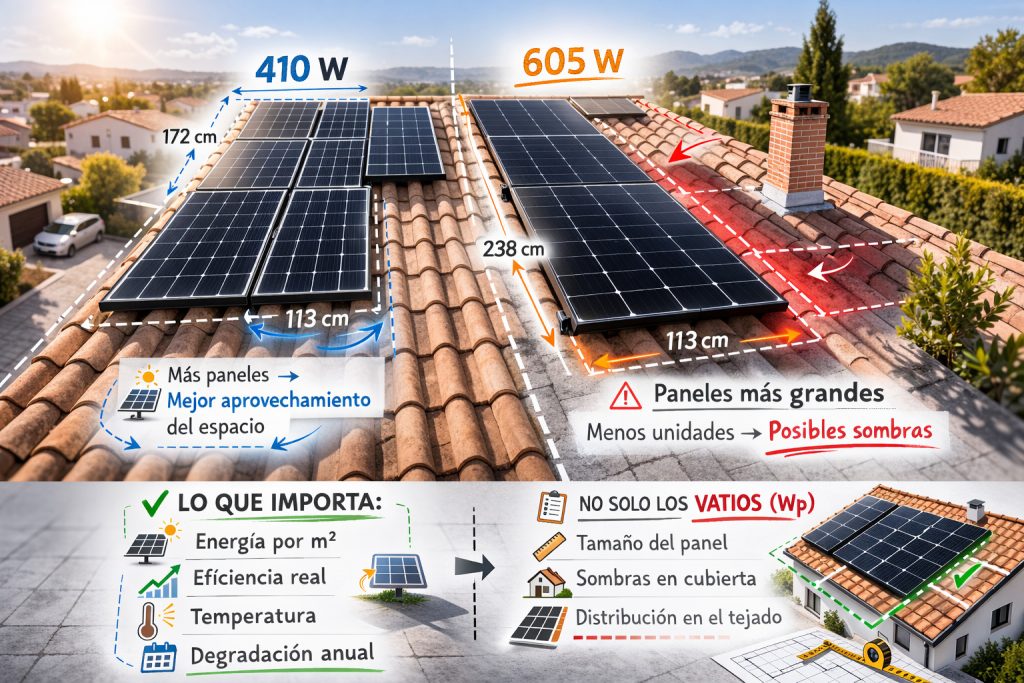
Many quotes compare 410 W, 550 W or 605 W panels as if the higher power is automatically superior. In reality, power is directly related to the physical size of the module. A more powerful panel is usually simply larger.
In residential installations, where the available space is conditioned by chimneys, recesses, shadows, slopes or aesthetics, the size of the panel can be a determining factor. An excessively large module can prevent an optimal distribution on the roof, reducing the total installed power or generating shadows between rows.
What really matters is not how many watts each panel has, but:
- How much energy it produces per square meter.
- How it behaves when the temperature rises.
- What annual degradation it shows.
- How it responds to shadows or dirt.
- What actual warranties are offered by the manufacturer.
Actual efficiency and long-term performance are much more relevant than the number of watts on the label.
2. Efficiency and real performance: the data that matters
The efficiency of a solar panel indicates what percentage of incident solar radiation is converted into useful electricity. Currently, conventional monocrystalline panels are typically between 19% and 22% efficient, while more advanced technologies exceed this range.
However, the efficiency declared in the laboratory is not synonymous with field performance. Actual performance depends on multiple factors:
- Operating temperature (panels lose power when heated).
- Orientation and inclination of the roof.
- Partial shading.
- Quality of internal welds.
- Losses due to connections or wiring.
- Natural degradation over the years.
A key aspect is the temperature coefficient. In hot climates such as southern Spain, cell temperatures can be well above the 25 °C reference temperature. A panel with a better temperature coefficient will lose less power when subjected to high temperatures, which translates into higher actual annual production.
Therefore, when comparing solar panels, it is essential to analyze not only the nominal power, but also their thermal performance and their guaranteed annual degradation.
3. Types of current solar panel technologies
The photovoltaic market has evolved significantly in recent years. The main technologies that currently dominate are:
Traditional monocrystalline panels
They are the most widespread and offer a good combination of cost and efficiency. They use monocrystalline silicon and are suitable for most residential and commercial applications.
TOPCon (n-type) technology
It represents an evolution compared to previous technologies such as PERC. TOPCon panels offer:
- Increased efficiency.
- Better thermal behavior.
- Lower initial degradation.
- Better performance in low irradiance conditions.
This technology is establishing itself as one of the high performance standards in today’s market.
Back contact technology
In this design, all electrical contacts are located at the rear of the cell. This eliminates shadows caused by the front lines (busbars) and improves radiation collection.
Advantages include:
- Higher energy density.
- Better performance in partial shading.
- More uniform aesthetics (all-black panel).
- Extended warranties on certain premium ranges.
Bifacial panels
They can capture radiation from both the front and the back. They are especially useful in elevated installations or on reflective surfaces where albedo can increase production.
In surface bonded decks, the bifacial benefit is usually limited.
4. Construction quality: what is not seen but determines the real durability of the panel.
When a solar panel is compared in a data sheet, the focus is usually on power, efficiency or warranty. However, the real performance of the module over 25 or 30 years depends on something that does not appear in a big way in the catalog: its internal construction quality.
A photovoltaic panel is not simply “a plate that generates electricity”. It is a multilayer laminated system subjected to:
- Constant ultraviolet radiation.
- Daily thermal cycling for decades.
- Humidity and condensation.
- Wind loads and mechanical pressure.
- Possible hail impacts.
- Vibrations during transport and assembly.
Each of the internal elements directly influences the service life of the module:
- Photovoltaic cells.
- Welds and interconnections.
- Encapsulant (EVA, POE or other polymers).
- Back sheet or second pane.
- Aluminum structural frame.
- Junction box and electrical connectors.
Two panels with the same power may behave completely differently after 10 years in the field if their internal construction is not equivalent.
4.1. Welds and microcracks: the invisible critical point
One of the most sensitive aspects of panel durability is the interconnections between cells. The individual cells are connected by ribbons and solder joints that allow the passage of electrical current throughout the module. The problem of thermal cycling.
Every day, a panel can experience thermal variations of more than 40 °C between night and midday. This cycle is repeated thousands of times during its lifetime.
Constant dilations and contractions generate:
- Mechanical fatigue in welds.
- Microcracks in silicon.
- Progressive weakening of interconnections.
If the welds are not robust or if the panel design allows too much structural flexing, hotspots may appear over time.
What is a hotspot and why is it dangerous?
A hotspot occurs when a cell or an area of the panel stops conducting current properly. Instead of producing power, that area becomes a resistance that dissipates energy in the form of heat.
Possible consequences:
- Significant loss of production.
- Accelerated degradation of the encapsulant.
- Risk of irreversible damage to the module.
In real installations, many failures are not due to the cell itself, but to micro-cracks generated by accumulated mechanical or thermal stress.
More resistant architectures
Some current technologies reduce this risk by:
- Half-cut design (cells cut in halves to reduce internal current).
- Shingled architecture (overlapping without traditional front welds).
- Back contact, where connections are concentrated in more protected areas.
These configurations can improve resilience to micro-cracking and thermal fatigue.
4.2. Back sheet vs. glass-glass: encapsulation and environmental protection
The encapsulation of the module is essential to protect the cells from moisture, oxygen and contaminants.
There are two major configurations:
Backsheet panels (backsheets)
In this traditional construction, the panel is composed of:
- Front glass.
- Encapsulant.
- Cells.
- Encapsulant.
- Multilayer polymeric back sheet.
The quality of the backing film is crucial. If the material is not UV or moisture resistant, they may appear:
- Surface cracks.
- Delamination.
- Moisture infiltration.
- Internal corrosion.
In normal environments, a quality backsheet can provide excellent performance for decades. The problem arises when lower quality materials are used in demanding environments.
Glass-glass panels
In this configuration, the back sheet is replaced by a second tempered glass.
Main advantages:
- Greater hermeticity against humidity.
- Greater resistance to saline environments.
- Lower gas permeability.
- Better performance against delamination.
This may be especially relevant in:
- Coastal areas with salt spray.
- Industrial environments with chemical particles.
- Regions with constant high humidity.
However, they also involve:
- Increased weight.
- Greater structural rigidity.
- Need for adequate support structures.
It is not that glass-glass is always better; it is more robust for certain environments.
4.3. Encapsulant: the silent protector
An encapsulant (usually EVA or more advanced variants such as POE) is used between the module layers.
Its function is:
- Protect cells.
- Vibration damping.
- Prevent the entry of humidity.
- Maintain optical transparency.
A poor quality encapsulant can yellow over time, reducing light transmission and directly affecting yield.
UV stability is critical to ensure that the module maintains its optical efficiency for decades.
4.4. Aluminum frame: structure and stability
The frame is not only used to attach the panel to the structure. It serves key structural functions.
A more robust frame:
- Reduces twisting during transport.
- Decreases internal stress in the cells.
- Improves resistance to wind loads.
- Reduces the risk of bending-induced microcracking.
In industrial projects or high wind areas, frame stiffness can make the difference between a stable panel and one under continuous stress.
In addition, the surface treatment of aluminum (anodizing) influences corrosion resistance in saline environments.
4.5. Junction box and connectors: Small details, big problems
The rear junction box houses the bypass diodes that protect the module against partial shading.
If the enclosure is not properly sealed or if the connectors are not of adequate quality, this can occur:
- Moisture infiltration.
- Corrosion.
- Electrical failures.
- Risk of electric arc.
In many field repairs, the problem is not in the cell, but in poorly executed connections or in the mixing of incompatible connectors.
5. Installation environment: not all solar panels are suitable for everything.
One of the most common mistakes when choosing solar panels is to think that any average quality module will perform the same in any environment. The reality is that the performance of a panel depends directly on where it will be installed and under what conditions it will operate for decades.
The environment not only influences energy production, but also structural durability, material degradation and the likelihood of failure in the medium and long term.
Making the right choice means adapting the panel technology to the actual context of use.
5.1. Residential installations
In a single-family house or residential building, the technical priorities are different from those of an industrial plant. Here there are often clear physical constraints: reduced available surface area, roof obstacles, varying slopes and, in many cases, aesthetic requirements.
Priority is given to this type of installation:
High efficiency per installed surface
On roofs where space is limited, efficiency is critical. A panel with higher performance per square meter allows more total power to be installed in less space. This can make the difference between covering 70 % of consumption or reaching 100 % of annual self-consumption.
In addition, on sloped roofs with less than perfect orientation, higher efficiency helps to compensate for deviations from the optimal south orientation.
Aesthetic integration
More and more homeowners are looking for panels with a full black finish or with discreet frames. Although aesthetics do not directly influence energy production, they do influence project acceptance, especially in single-family homes or urban environments.
Back contact technologies or designs with fewer front busbars offer a more uniform appearance.
Behavior in partial shadows
In residential environments it is common to find shadows cast by chimneys, antennas, nearby trees or adjacent buildings.
When a conventional panel is partially shaded, partial shading can occur:
- Significant reduction in production throughout the string.
- Appearance of hotspots.
- Additional stress on certain cells.
In these cases it is advisable to opt for:
- Panels with architectures that better manage partial shading.
- Systems with microinverters or optimizers that decouple the performance of each module.
Individual monitoring
In small installations, the ability to monitor panel by panel brings significant advantages:
- Early detection of faults.
- Verification of compliance with performance guarantees.
- Maintenance optimization.
In homes where the homeowner wants precise control of their system, this option can be key.
5.2. Industrial installations
In large industrial roofs or above-ground plants, the approach changes. Here the scale of the project introduces additional economic and structural variables.
In these cases, priority is given:
Competitive cost per watt
In larger projects, small differences in the cost per Wp can make a big difference in the total investment. Therefore, the balance between efficiency, price and durability is critical.
However, reducing costs should not mean sacrificing structural quality or solid guarantees.
Structural robustness
Industrial roofs may be subjected to:
- Higher wind loads.
- Increased thermal exposure.
- Structural vibrations.
A stiffer framed panel with better mechanical strength will reduce the risk of internal micro-cracking and weld fatigue.
Ease of maintenance
In industrial installations, accessibility and periodic maintenance are determining factors. More robust panels with less sensitivity to dirt or chemical degradation will reduce operation and maintenance (O&M) costs.
Thermal performance
In large metal roofs, the ambient temperature can be high. Panels with better temperature coefficient will offer higher actual annual production, which directly impacts the profitability of the project.
Aggressive environments
There are locations where environmental conditions can accelerate material degradation if the module is not properly selected.
These environments include:
- Coastal areas with salt spray.
- Industrial areas with suspended chemical particles.
- Quarries or environments with abrasive dust.
- Regions with frequent hail or extreme weather events.
In these cases it becomes especially important:
Module sealing and potting
Glass-to-glass panels offer a more hermetic encapsulation against moisture and external agents. This construction can provide greater durability in environments where conventional back sheeting might degrade prematurely.
Certified mechanical resistance
It is important to review:
- Maximum supported loads (pressure and suction).
- Certifications against hail impact.
- Resistance to corrosion by salt spray or ammonia.
A module designed for standard environments may not be the best choice in a chemically aggressive environment.
6. Warranties: product and performance in real perspective
Solar panel warranties must be interpreted with technical and business criteria.
There are two main types:
6.1. Product warranty
Covers manufacturing defects and structural failures of the module. It usually ranges from 10 to 40 years depending on the manufacturer and range.
A longer warranty period may indicate:
- Increased manufacturer’s confidence in your design.
- Better quality of materials.
- Lowest historical incidence rate.
However, the warranty is only valuable if the manufacturer has a solid track record and sufficient financial backing to respond for decades.
6.2. Performance or production guarantee
It guarantees that the panel will maintain a minimum percentage of its original power after a certain number of years.
Usually:
- 90 % after 10-12 years.
- 80-87 % after 25-30 years.
Some premium manufacturers offer very low linear degradations (e.g. 0.25% per year), which means higher cumulative production over the lifetime of the system.
It is important to understand that cumulative production over 30 years has much more economic impact than a small initial difference in price per panel.
7. Monitoring and control: microinverters vs. central inverter.
The overall performance of an installation does not depend solely on the panel. The associated electronics play a decisive role.
7.1. Microinverters
Each panel converts its power from direct current to alternating current independently.
This allows:
- Individualized monitoring.
- Fault isolation.
- Better performance on roofs with shadows or multiple orientations.
- Increased electrical safety by working with lower DC voltage.
They are especially recommended for complex or residential roofs with multiple planes.
7.2. String inverters (central)
They connect several panels in series forming strings.
Main advantages:
- Lower cost per watt.
- Simplicity in homogeneous installations.
- High efficiency in well-designed systems without shadows.
In industrial installations with uniform orientation and absence of obstacles, they are usually the most economically rational option.
The choice between one system or the other should be based on the technical analysis of the roof, not solely on price.
Conclusion: how to choose the right solar panel
Choosing the right panel requires a global vision of the project. It is not a matter of comparing catalogs, but of understanding the module’s performance over decades.
Before deciding, it is advisable to analyze:
- Actual efficiency and temperature coefficient.
- Construction quality and mechanical resistance.
- Cell technology and internal architecture.
- Guaranteed annual degradation.
- Specific installation environment.
- Warranties backed by solid manufacturers.
- Monitoring system appropriate to the desired level of control.
Solar energy is a long-term investment. Two panels may look identical on a data sheet, but differ greatly in their actual performance after years of exposure.
Making the right choice is not a matter of fashion or power rating. It is a technical decision that must be based on engineering criteria, durability and consistency with the environment where the system will operate.
If you want to go even deeper into all these aspects, we have prepared a video where we analyze in detail the different types of panels, their real differences and how to choose the most suitable for each case. You can watch it on our YouTube channel:
For more content, visit our social media channels: