


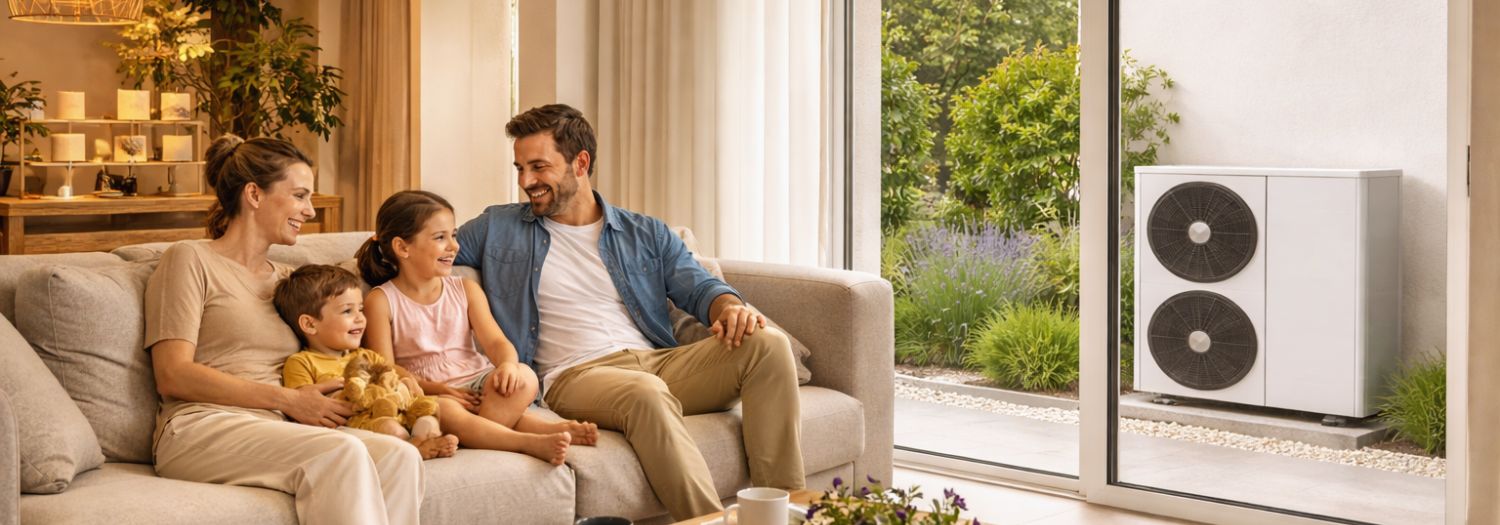
If you’re reading this article, you’re probably looking for information about air source heat pumps in Málaga and wondering whether they’re really a good option for your home. That’s completely normal. Aerothermal energy systems have become one of the most talked-about heating and cooling solutions in recent years, especially in areas with a mild climate like Málaga, but they’re also one of the technologies that raise the most questions.
Not only because they “sound like a new technology”, but because they bring together concepts such as heat pumps, outdoor air, heating, cooling and domestic hot water. It’s easy to think: “Okay, but… what exactly is this, and why do so many people recommend it?”
Many people wonder what aerothermal energy actually is, how it works, how it differs from a traditional air conditioning system, or whether it’s suitable for their type of home. Very specific questions also come up, such as whether it works well in apartments, if it can be used with conventional radiators, or if the energy savings are really noticeable.
In this article, we explain everything in a clear and straightforward way, while still giving you the level of detail you need to make an informed decision. You’ll understand why more and more homeowners are choosing air source heat pump systems and what key factors you should consider before installing one.
What Is Aerothermal Energy?
Simply put, aerothermal energy is a climate control system that uses a heat pump to extract energy from the outdoor air and use it to heat and cool a home. With a single system, it’s possible to provide heating in winter, cooling in summer, and domestic hot water all year round.
In other words, we’re not talking about just “a heating device”, but a comprehensive solution designed to deliver thermal comfort for both homes and commercial properties.
What makes aerothermal energy especially interesting is that a large portion of the energy it uses is not generated from fuels, but extracted directly from the outdoor air. That’s why it’s considered a renewable and highly efficient technology: under normal conditions, it can harness around 75% of ambient energy, requiring only a smaller percentage of electricity to operate the system.
This doesn’t mean it’s “free”, but it does mean that the balance between energy consumed and energy delivered is far more favourable than with traditional heating and cooling systems.
Although it may be surprising, even when outdoor temperatures are low, the air still contains usable energy. Aerothermal systems are able to extract this energy and convert it into useful heating or cooling through a reversible thermodynamic cycle.
Thanks to this process, air source heat pumps achieve high energy performance with significantly lower electricity consumption compared to traditional systems. And because there is no combustion involved, there’s no boiler, no smoke, no emissions and no waste, eliminating much of the complexity associated with fuels such as gas or oil.
Before taking a deeper look at how an aerothermal system works, it’s helpful to first understand how traditional air conditioning systems operate, as many people tend to confuse the two technologies.
How Does a Traditional Air Conditioning System (Split Unit) Work?
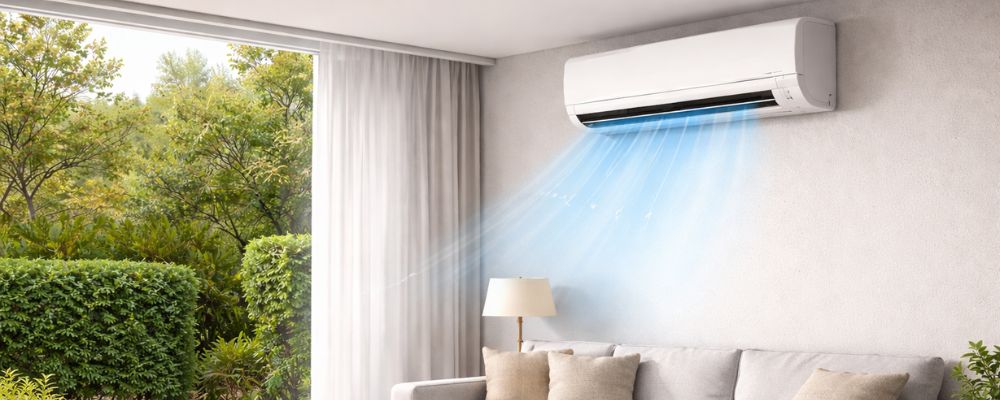
Split-type air conditioning systems work by transferring heat from one place to another using a refrigerant that circulates in a closed loop between an indoor unit and an outdoor unit. This refrigerant absorbs heat in one location and releases it in another, depending on the operating mode of the system.
In other words, it doesn’t actually “create” cold or heat, but rather moves thermal energy between the inside and the outside of the building.
In cooling mode, an air conditioning system absorbs heat from inside the home and releases it outdoors, lowering the indoor temperature. Many modern units include a reversing valve that allows the cycle to be inverted so the system can also operate in heating mode. In this case, it extracts heat from the outdoor air and brings it indoors.
This is why many people say, “my air conditioner can heat as well, so… isn’t that aerothermal energy?” It’s a very common—and completely understandable—confusion.
The key difference lies in the approach and the overall climate control capacity. While this type of system can be useful for conditioning individual rooms, it’s not designed to provide homogeneous climate control throughout an entire home, nor to integrate with a water-based heating system.
In addition, its efficiency and comfort levels are generally lower when compared to systems specifically designed for whole-home climate control, such as aerothermal systems. These are engineered to serve the entire property and also supply domestic hot water, offering a much more comprehensive solution.
How Does Aerothermal Energy Work and Why Is Water So Important?
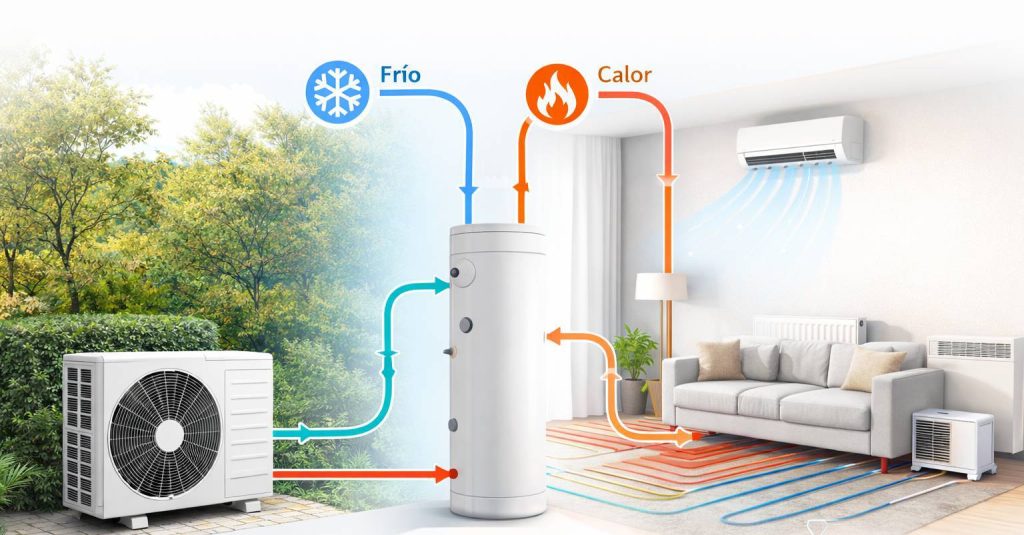
Aerothermal energy also uses a heat pump with a reversing valve, but its approach is different. The key difference is that it’s designed to provide climate control for the entire home and to work mainly with water-based distribution systems. This point is crucial: water is an excellent medium for transporting thermal energy, which allows heat or cooling to be distributed more evenly and efficiently throughout the property.
Instead of delivering hot or cold air directly, the heat pump transfers the energy extracted from the outdoor air into a water circuit. This water is then distributed throughout the home via systems such as underfloor heating, low-temperature radiators or fan coil units, allowing for a more even and comfortable indoor climate.
This means you don’t rely on air currents to feel warm or cool, but rather enjoy a more stable, balanced temperature across the entire space.
In heating mode, an aerothermal system extracts heat from the outdoor air and transfers it to the water circulating through the home’s heating system. In cooling mode, the process is reversed, allowing the property to be cooled efficiently (provided the distribution system is designed for cooling, such as fan coil units or underfloor cooling).
In addition, the system can produce domestic hot water (DHW), which significantly increases its versatility and overall energy efficiency. With a single system, it’s possible to cover almost all of a home’s thermal needs throughout the year.
From a technical perspective, this is achieved through a thermodynamic cycle that uses a refrigerant. A fan draws outdoor air into the heat exchanger, where the refrigerant absorbs energy and changes state. The compressor then increases the pressure and temperature of the refrigerant, and finally, this energy is transferred to the water circuit.
The practical result is simple: heating in winter, cooling in summer, and domestic hot water all year round, with optimised electricity consumption and high overall efficiency.
Why Does Aerothermal Energy Work So Well in Málaga?
Málaga’s climate is one of the greatest advantages for aerothermal energy systems. Mild temperatures throughout most of the year allow the heat pump to operate under optimal conditions, delivering high performance with controlled energy consumption.
Why is this important? Because the smaller the temperature difference between the outdoor air and the desired indoor temperature, the easier the heat pump works and the higher its efficiency throughout the year.
This makes air source heat pump installation in Málaga particularly attractive compared to regions with more extreme climates. In addition, many homes in Málaga look for an “all-in-one” solution, as they combine mild winters—where some heating is needed, but not excessively—with hot summers, when cooling becomes essential.
Having a single system that efficiently covers both scenarios, while also providing domestic hot water, makes perfect sense from both a comfort and energy efficiency perspective.
Another key advantage is that aerothermal systems integrate extremely well with other energy solutions that are increasingly common in the region, such as solar energy. When aerothermal energy is combined with solar panels, part of the electricity required to run the system can be generated on-site, further improving the home’s overall energy efficiency and reducing reliance on the grid.
At Ubora, this is actually an approach we work with very often: electrifying heating and cooling systems and, whenever it makes sense, combining them with solar self-consumption to maximise performance and long-term results.
Is Aerothermal Energy Suitable for Every Type of Home?
One of the most common questions is whether aerothermal energy is suitable for every type of home. The reality is that it’s a very versatile system, but not all properties start from the same conditions. Factors such as the size of the property, the level of insulation, the existing heating system, and whether it’s a new build or a renovation have a direct impact on the final performance.
In single-family homes and well-insulated apartments—even properties of around 90 to 100 square metres—an aerothermal system can deliver high levels of comfort and efficiency. However, for it to work properly, it’s not enough to simply “install the unit”. A detailed preliminary study is essential to correctly define the heat distribution system, size the equipment accurately, and determine how heating and cooling will be delivered throughout the home.
This type of assessment helps prevent common issues such as insufficient output, frequent start-stop cycles, or uneven comfort levels in different rooms.
In renovation projects, it’s also important to assess whether part of the existing installation can be retained (for example, traditional water radiators) or if it’s better to upgrade to low-temperature emitters. The good news is that aerothermal systems offer solutions for different scenarios: from underfloor heating installations to systems using radiators, fan coil units, or a combination of both.
That’s why, rather than asking “is it possible?”, the right question is usually: “how should it be designed so it works optimally in my home?”
Energy Consumption and Energy Efficiency of Aerothermal Systems
One of the main advantages of aerothermal systems is their high energy efficiency. Rather than generating heat directly, these systems transfer thermal energy from the outdoor air into the home. As a result, the amount of usable thermal energy produced is significantly higher than the electrical energy required to operate the system.
In simple terms, with a relatively small amount of electricity, the system is able to move a large amount of thermal energy.
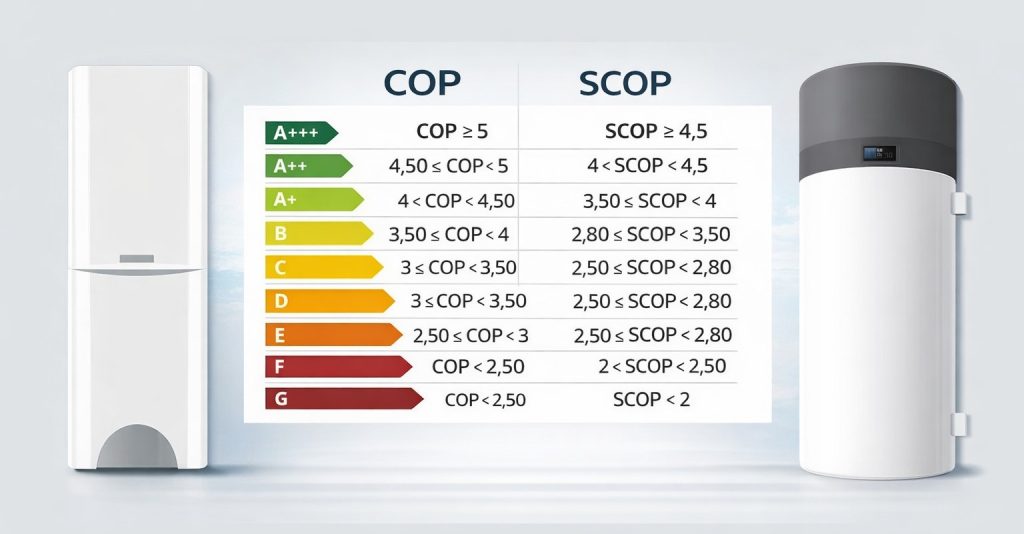
In the world of aerothermal energy, two key concepts are used to measure efficiency: COP and SCOP. COP (Coefficient of Performance) measures efficiency at a specific moment, usually under standard test conditions, while SCOP (Seasonal Coefficient of Performance) represents seasonal efficiency over the course of a year, taking into account real temperatures and continuous operation.
What really matters for you as a user is the overall idea: the higher the efficiency, the less electricity is needed to achieve the same level of thermal comfort.
In practice, this results in optimised electricity consumption compared to traditional heating and cooling systems. Actual energy consumption will depend on factors such as daily usage patterns, the level of insulation in the home, domestic hot water demand, the type of heat emitters used, and the local climate.
That said, aerothermal systems generally stand out for their ability to provide year-round climate control with efficient energy use, especially when they are designed with suitable emitters such as underfloor heating or low-temperature radiators.
Another very important advantage is that aerothermal systems allow an entire home to operate exclusively on electricity, avoiding reliance on gas or other fossil fuels. This simplifies energy supplies and, in many cases, improves safety and reduces maintenance by eliminating combustion altogether.
When combined with solar self-consumption, the system can achieve even higher levels of efficiency and significantly reduce overall energy dependence.
Does Aerothermal Energy Have Any Drawbacks?
Like any technology, aerothermal energy also has aspects that should be understood before making a decision. The main drawback is that it requires proper planning. A poorly designed or incorrectly sized installation can negatively affect both system performance and indoor comfort.
That’s why it’s so important not to focus solely on “installing a unit”, but on designing the entire system correctly from the outset.
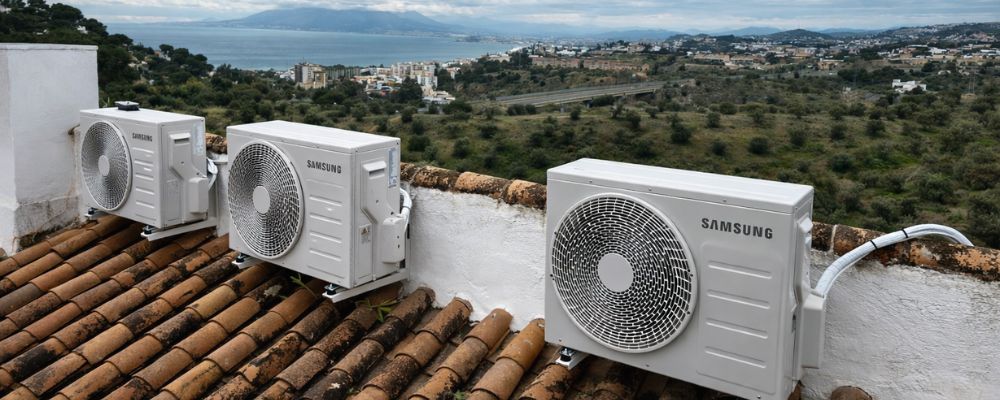
Another aspect to consider is that an aerothermal system requires an outdoor unit, as it extracts energy from the outside air. This means having a suitable space available—such as a terrace, patio, rooftop or garden—and carefully considering factors like placement, ventilation and noise levels.
That said, modern heat pump systems are generally very quiet when installed correctly and with proper planning.
In addition, aerothermal systems perform especially well with low-temperature distribution systems, which means that in homes with traditional radiators, certain adaptations may be required to fully take advantage of their potential. In some cases, part of the existing installation can be retained, but it’s essential to assess whether it’s compatible with the type of heat pump, the required flow temperature and the expected comfort level.
For this reason, working with a specialised aerothermal energy company in Málaga is key, as each property should be analysed on a case-by-case basis to ensure optimal performance.
That said, when an aerothermal system is properly designed and correctly installed, the benefits in terms of comfort, energy efficiency and simplified climate control usually far outweigh these considerations.
Why Choose a Specialist Aerothermal Energy Company in Málaga
Aerothermal energy is a highly efficient technology, but its proper performance depends largely on the design and execution of the installation. Working with a specialised company makes it possible to carry out a thorough preliminary assessment, select the most suitable system, and ensure an installation tailored to each property.
This includes analysing insulation levels, actual thermal demand, heat emitters, domestic hot water production, and the best way to integrate all components without oversizing or falling short.
At Ubora, we install next-generation aerothermal systems that harness energy from the outdoor air to provide year-round climate control for homes and businesses. It’s an efficient, clean, and combustion-free solution: with a single system, you get heating in winter, cooling in summer, and continuous domestic hot water, all with minimal electricity consumption.
We work with leading brands in technology, efficiency, and reliability such as Samsung and Daikin, offering quiet, versatile systems that adapt seamlessly to single-family homes, commercial premises, and larger-scale buildings.
A well-designed system not only ensures greater comfort, but also improves long-term durability and energy performance. And when it comes to a system that will be part of your home for many years, that makes a significant difference.
For more content, visit our social media channels: